Showing posts with label I reach for my..... Show all posts

Monday, October 01, 2007

art and/or culture

Just in passing – a note on art and/or culture provoked by Poli-talk on such matters in election 2007 policy announcements.

“One of the problems with the new administrative reforms both on the Nordic as well as European level, which also resulted with NIFCA being closed in Finland, is that no differentiation is made between culture and arts. All is culture: sport is culture, food is culture, everything is basically culture. Maybe the only thing that is not culture is contemporary art.”

An extract from Between a Rock and a Hard Place – the Possibilities for Contemporary Art Institutions to Function as Critical Political Spaces.
By Marita Muukkonen.
Part of the Public Preparation series for the upcoming Biennale of Young Artists in Estonia, and a document that will form the basis for discussion at Market Gallery in collaboration with variant magazine.

Worth a read.

See also “I reach for my…” tagged posts on Back Page.

Monday, December 25, 2006

Ern Malley. A frisson of text.

Detail of Ern Malley, painting by Sidney Nolan, from Collected Poems paperback cover.
….
We will be wraiths and wreaths of tissue-paper
To clog the Town Council in their plans.
Culture forsooth! Albert, get my gun.

….
But in all of this I got no culture till
I read a little pamphlet on my thighs
Entitled: ‘Friction as a social process’

Ern Malley.
Extract from Culture as Exhibit.
Circa 1943.
Collected Poems, Angus & Robertson, 1993.

Wednesday, November 15, 2006

Culture is the Enemy of Art

"Culture is the enemy of Art"

Frank Sartor, quoted in the Express Advocate when launching the Gosford City Plan:
"People will accept development if they think it adds culture to the place"

I reach for my Goering.
(see "the wife likes that sort of thing" and "Goering got it wrong" posts)

Friday, October 27, 2006

“The wife likes that sort of thing”


“The arts” or ‘Art’? What’s the difference?

‘Art’ as distinct to ‘the arts’ has had a specificity since the 19th Century. The term is associated with an idea that the artist’s creative life offers unique insight or potentially transforming revelation (see E.B. Browning and Daily Telegraph article in ‘Goering’ post, 25-10-06).

‘The arts’, and/or crafts, which includes painting, pottery, quilting, sculpture, carpentry, shoe making etc. on the other hand has a continuity of material practice through time, and still today produces valid and valued forms for aesthetic contemplation and enjoyment. We could say that ‘Art’ is a possible, but not essential attribute of ‘the arts’, and that ‘Art’ can exist independently of the material forms that are its customary vehicles i.e. ‘the arts’.

Why does this matter?

That depends on your point of view. For one thing most observers, certainly critics, contemporary theorists and others of their ilk, privilege contemporary ‘Art’ as worthy of greater regard, and, most importantly consider it significant for its contentiousness. That is, an art that contains ‘Art’, and as such is marked by modern (or post-modern) radicality, so making it dangerous to some.

What is this thing called ‘Art’?

This is not a question that is simply answered.
It could be described as a method, an attitude, a way of knowing and being, a cerebral and emotional ‘technology’, a process of coming to awareness, a critical engagement with the cognitive and perceptual frameworks that constitute assumed reality, a quest of psychological and philosophical inquiry. In short it is a form of inquiry and reflection about contemporary culture that communicates in a way that is critically conceptual and challenging. That is why it matters. That is why controlling regimes like it shut (shot) down.

‘Art’ occupies an important niche in the social environment and functions as a crucial element in democratic, civic and intellectual life. This is particularly so in the current circumstances of saturation government and corporate spin and the narrowing of the channels of media information. Through its language of sign, symbol and metaphor, it can, with some impunity, question the prevailing values that ruling elites manipulate to maintain power – patriotism, religion, ‘the market’, identity (racial, cultural) etc.

One of the effects of the semantic dissolve of culture, the arts and ‘Art’, (Goering post 25-10-06) is to “decommission” ‘Art’ while keeping “the arts” – to eliminate those culturally and politically uncomfortable, antisocial aspects of ‘Art’.
Perhaps it was ‘Art’ that got Goering’s goat; culture was not the target.


At the local level it is convenient for culture activists to base support for culture on instrumental grounds, not on ‘Art’s’ intrinsic value and its freedom to express, criticise, contest and interrogate. However the danger is that is easier to close cultural programmes (the arts and ‘Art’) on grounds of cost effectiveness, than to directly argue for the closure of critical debate about our politics and values, which is possible when there is no articulation of the differences.

Or you can foreclose: “Council is concerned that the Culture that develops in Gosford reflects our values and is never in conflict with them.” (Gosford City Cultural Plan – Action Plan.)

Or if you prefer Counter Culture: “In collaboration with Space Furniture, CounterArt is offering artists an opportunity to exhibit their work within its new gallery space in Sydney.” The cultural revolution meets retail values at a store near you in time for Christmas.

Another parting shot from the Browning: Robert this time.

“Tis you speak, that’s your error. Song’s our art:
Whereas you please to speak these naked thoughts
Instead of draping them in sights and sounds.
– True thoughts, good thoughts, thoughts fit to treasure up!
But why such long prolusion and display
Such turning and adjustment of the harp,
And taking it upon your breast, at length,
Only to speak dry words across its strings?
Stark-naked thought is in request enough:……”
From Transcendentalism, a poem in twelve books.

Wednesday, October 25, 2006

Goering got it Wrong


Goering got it Wrong

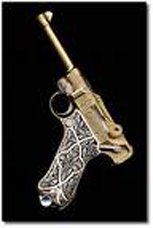
Goering is said to have been fond of saying, When I hear the word 'culture' I reach for my gun. The original line, "When I hear "culture" I release the safety catch on my Browning!", comes from Hanns Johst’s play Schlageter performed in 1933 for Hitler’s birthday.
What was it that worried the second-in-command of yet another of histories book-burning repressive regimes? What was the threat from culture?

We tend these days to semantically dissolve Culture, the Arts and Art into an expedient mess from which no useful conceptual or strategic model can be constructed. Add to this mix, recreation, and sport (NSW Dept. of the Arts Recreation and Sport, Rod Kemp Minister for the Arts and Sport, in the UK, the Department of Culture, Media and Sport, etc.) and it is no wonder that it is difficult to make a public case for specific planning measures, and difficult to see what was spooking Goering.

“By ‘culture’, Goering probably meant the old literary civilisation typified by Goethe and Schiller rather than opera houses and galleries, but it's difficult to be sure because the semantics of "culture" are even more complex than those of "the arts". Nowadays the word has pretty much lost its original sense of "a process of nurtured development" and operates under several levels of meaning, all of them vague.

The sloppiest modern usage makes "culture" synonymous with "the arts"… several efforts have been made to find a new vocabulary that dissolves the entailed misconceptions. The result is that the use of the words "the arts" and "culture" is fading: instead, we've come up with the peculiar bastardised notion of "multiculturalism" and more neutral terms such as "recreation" or "leisure activity" (a phrase that comes close to self-contradiction).
The latest Blair-approved wheezes are "creative industry" and "creative partnership" - Culture Secretary Tessa Jowell recently prophesied, in an unfortunate image, "an avalanche of creativity". Scratch at the agenda there, and you find an implication that 'the Arts' need to get off their backside, stop relying on public money and engage with commercial imperatives.

And that, inexorably, is the way that things are going. The arts can only be justified if they feed into some great pumping-station of urban regeneration. Culture is no longer a matter of a lifetime of slow, meditative looking, reading and listening - it's gone ‘fast-food’.” Extract from the UK Daily Telegraph.


Nasi Goering - Pop Culture, Pop Art.

The following ‘mission statement' is a good example of the institutionalisation of this confusion between culture and the arts, and most significantly, of the complete omission of Art, as a distinct conceptual entity.

Making the Case for Culture.
"Culture or 'the arts' takes on many forms: painting, writing, quilting, pottery, museums, landmarks, sculptures, landscapes, streetscapes, memorials, sport. It is a way for individuals and communities to express and engage themselves with family, friends, and their neighbourhoods, their communities. Culture can be used to renew or revitalize municipalities, regions, even a country. It can build community identity and pride, strengthen bonds, improve quality of life on all socioeconomic levels, and engage children and youth in education and their environment. Culture can be the catalyst for positive change, engaging all ages and communities. Diversity can be embraced through culture, building trust and understanding. And culture can act as the economic engine that drives municipalities toward growth and prosperity."

I reach for my Browning….

"Revolving pistols are ingenious things,
But prudent men (Academicians are)
Scarce keep them in the cupboard next the prunes"

Elizabeth Barrett Browning, who also wrote in the same poem Aurora Leigh:

"While Art
Sets action on top of suffering:
The artist’s part is both to be and do,
Transfixing with a special, central power
The flat experience of the common man,
And turning outward, with a sudden wrench,
Half agony, half ecstasy, the thing
He feels the inmost, - never felt the less
Because he sings it."


As artists we need to be able to articulate what it is that distinguishes Art from “the arts”, what makes it a unique aspect of culture (And why it worried Goering).

More in a later post…"the wife likes that sort of thing".