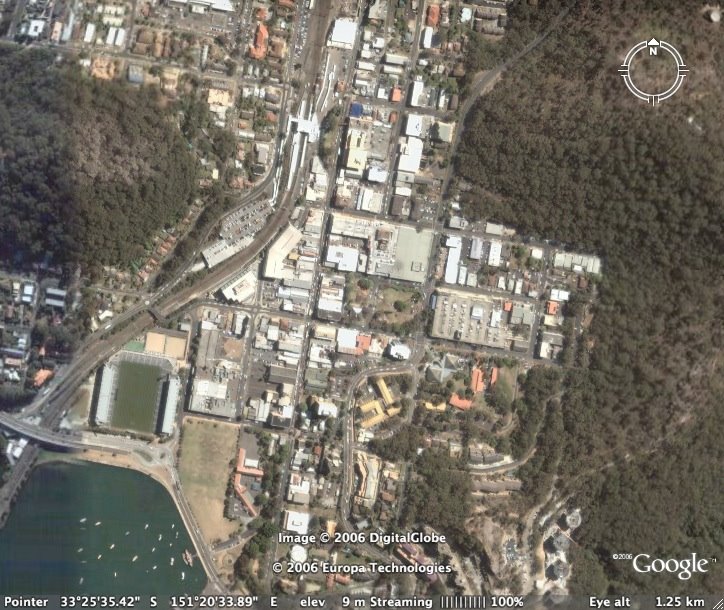
At a time when planning strategies for Gosford and the region are being developed, involving different levels of government, theories and practices from a variety of disciplines can perhaps offer useful perspectives on the process.
The following extracts will be familiar to Reading Room Project artists, and might provoke some ideas more generally. They have served to define the starting point for an art event in development.
Deleuze and Guattari’s concept of smooth and striated space, as outlined below, has application to living in the result of past regional planning strategies, which resulted in a meandering, horizontal and dispersed geography. They have also produced commercial and retail real-estate outcomes in the CBD akin to that of the Israeli military in Lebanon.
The first extract is by Eyal Weizman, an architect, writer and Director of Goldsmith's College Centre for Research Architecture. In this article he looks at the use of Deleuze and Guattari by military planners.
“The reading lists of contemporary military institutions include works from around 1968 (with a special emphasis on the writings of Gilles Deleuze, Félix Guattari and Guy Debord), as well as more contemporary writings on urbanism, psychology, cybernetics, post-colonial and post-Structuralist theory. If, as some writers claim, the space for criticality has withered away in late 20th-century capitalist culture, it seems now to have found a place to flourish in the military.
(Naveh, Israeli commander, in conversation with Weizman) ‘This is why that we opted for the methodology of moving through walls. . . . Like a worm that eats its way forward, emerging at points and then disappearing. I said to my troops, "Friends! If until now you were used to move along roads and sidewalks, forget it! From now on we all walk through walls!’
This form of movement, described by the military as 'infestation', seeks to redefine inside as outside, and domestic interiors as thoroughfares. The IDF's strategy of 'walking through walls' involves a conception of the city as not just the site but also the very medium of warfare a flexible, almost liquid medium that is forever contingent and in flux.
I asked Naveh why Deleuze and Guattari were so popular with the Israeli military. He replied that, 'several of the concepts in A Thousand Plateaux became instrumental for us allowing us to explain contemporary situations in a way that we could not have otherwise. It problematized our own paradigms. Most important was the distinction they have pointed out between the concepts of "smooth" and "striated" space [which accordingly reflect] the organizational
concepts of the "war machine" and the "state apparatus". In the IDF we now often use the term "to smooth out space" when we want to refer to operation in a space as if it had no borders.
In addition to these theoretical positions, Naveh references such canonical elements of urban theory as the Situationist practices of dérive (a method of drifting through a city based on what the Situationists referred to as 'psycho-geography') and détournement (the adaptation of abandoned buildings for purposes other than those they were designed to perform). These ideas were, of course, conceived by Guy Debord and other members of the Situationist International to challenge the built hierarchy of the capitalist city and break down distinctions between private and public, inside and outside, use and function, replacing private space with a 'borderless' public surface.”
Full text at: http://www.frieze.com/feature_single.asp?f=1165
The next extract explains Debord’s idea of the dérive and draws attention to the psychological dimension of geography as it is lived.
Theory of the Dérive - Guy Debord, Les Lèvres Nues #9 (November 1956)
“One of the basic situationist practices is the dérive [literally: “drifting”], a technique of rapid passage through varied ambiances. Dérives involve playful-constructive behavior and awareness of psychogeographical effects, and are thus quite different from the classic notions of journey or stroll.
In a dérive one or more persons during a certain period drop their relations, their work and leisure activities, and all their other usual motives for movement and action, and let themselves be drawn by the attractions of the terrain and the encounters they find there. Chance is a less important factor in this activity than one might think: from a dérive point of view cities have psychogeographical contours, with constant currents, fixed points and vortexes that strongly discourage entry into or exit from certain zones.
But the dérive includes both this letting-go and its necessary contradiction: the domination of psychogeographical variations by the knowledge and calculation of their possibilities. In this latter regard, ecological science — despite the narrow social space to which it limits itself — provides psychogeography with abundant data.
The ecological analysis of the absolute or relative character of fissures in the urban network, of the role of microclimates, of distinct neighborhoods with no relation to administrative boundaries, and above all of the dominating action of centers of attraction, must be utilized and completed by psychogeographical methods. The objective passional terrain of the dérive must be defined in accordance both with its own logic and with its relations with social morphology.”
Full text at: www.cddc.vt.edu/sionline/si/theory.html
The final extract is from Nomad Art by Deleuze and Guattari in A Thousand Plateaux.
“Several notions, both practical and theoretical, are suitable for defining nomad art and its successors (barbarian, gothic and modern). In the first place, "close-range" vision as distinguished from long-range vision; second, "tactile", or rather "haptic" space as distinguished from optical space. "Haptic" is a better word than "tactile", since it does not establish an opposition between two sense organs, but invites the assumption that the eye itself may fulfil this non-optical function. It was Alois Riegl who, in some marvellous pages, gave fundamental aesthetic status to the couple close vision-haptic space. For the moment, however, we should set aside the criteria proposed by Riegl, Wilhelm Worringer and more recently Henri Maldiney, and take some risks ourselves, making free use of these notions. It seems to us that smooth space (a) is both the object of a close vision par excellence and the element of a haptic space (which may be visual or auditory as much as tactile). Striated space, on the contrary, relates to a more distant vision and a more optical space, even though the eye is not the only organ to have this capacity. Once again, as always, this analysis must be corrected by a coefficient of transformation according to which movements between striated and smooth are at once necessary and uncertain, hence all the more disruptive.
The opposition between striated and smooth space is not simply that between the global and the local. For in the one case the global is still relative, whereas in the other the local is already absolute. Where there is close vision, space is not visual, or rather the eye itself has a haptic, non-optical function: no line separates earth from sky, which are of the same substance; neither is there any horizon, background, perspective, limit, outline or form, or centre; there is no intermediary distance, or all distance is intermediary.
EXPLANATORY NOTES
a. Smooth space is "an open space throughout which thing-flows are distributed, rather than (...) a closed space for linear and solid things. II is a vectorial projective or topological space" as opposed to a "metric space: in the first case 'space is occupied without being counted'. while in the second case ‘space is counted in order to he occupied ( ...) Sedentary space is striated, by walls, enclosures and roads between enclosures, while nomad space is smooth, marked only by 'traits' that are effaced and displaced with the trajectory (...) Every point is a relay and exists only as a relay (...), the in-between has taken on all the consistency ." (Mille plateaux, Ch. 12, pp. 447 and 471)
b. "The nomad, nomad space, is localised and not delimited. What is both limited and limiting is striated space, the relative global: it is limited in its parts, which are assigned constant directions, oriented in relation to one another, divisible by boundaries, and can be interconnected. What is limiting (...) is this totality in relation to the smooth spaces it 'contains“, the growth of which it slows or prevents, and which it restricts or places outside. Even when the nomad suffers its effects, he does not assume this relatively global character, where one passes from one point to another, from one region to another. Rather, he is in a local absolute', an absolute that is manifested locally, and engendered in a series of local operations of varying orientation." (p. 474)
c. "The nomad distributes himself in a smooth space, he occupies, inhabits, holds that space. This is his territorial principle. It is therefore false lo define the nomad by movement. Toynbee is profoundly right to suggest that the nomad is on the contrary he who does not move. Whereas the migrant leaves behind a milieu that has become amorphous or hostile, the nomad is one who clings to the smooth space left behind by the receding forest, where the steppe or desert advance." (p. 472)